
Turning biodiversity data into action
Our GBIF Workshop 2025 report is now available, capturing the discussions, insights and practical outcomes from a focused, multi agency workshop on how New Zealand can better mobilise, govern and use biodiversity data through the Global Biodiversity Information Facility (GBIF).
The workshop brought together central and local government practitioners to explore how GBIF infrastructure can support national priorities – from biodiversity monitoring and reporting to Indigenous Data Governance and international commitments.
A blueprint for a stronger national GBIF node and federated environmental information system
The report from the GBIF New Zealand Workshop (25 August 2025) captures what central and regional government biodiversity data practitioners identified as the most practical ways to strengthen Aotearoa New Zealand’s biodiversity and biosecurity data system through the Global Biodiversity Information Facility (GBIF).
The workshop confirmed a shared challenge:
- New Zealand’s environmental information remains complex, fragmented, duplicated, gappy, hard to access, and lacking strong leadership and consistent standards. The Parliamentary Commissioner for the Environment (PCE) has repeatedly recommended federated data systems, and highlighted GBIF (alongside the Atlas of Living Australia) as working examples of how federated approaches can succeed.
The workshop also confirmed a shared opportunity:
- with coordinated investment and support for the existing GBIF node and national infrastructure like New Zealand Organisms Register (NZOR), GBIF can become a cornerstone of a more effective, interoperable and internationally visible biodiversity information system.
Why this matters now
This work aligns directly with:
Local, Regional and National level Management and Decision making
- Biodiversity and biosecurity data underpins planning, consenting, conservation, pest management, infrastructure delivery and compliance functions, yet is currently fragmented, inconsistent and difficult to reuse across agencies.
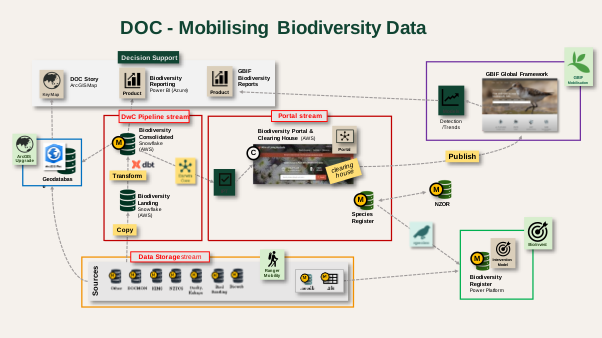
- The workshop identified GBIF and associated national infrastructure as a practical way to support federated access to trusted, standardised data, reducing duplication and strengthening evidence for regulatory, biodiversity, biosecurity and infrastructure decisions.
National priorities: Aotearoa New Zealand Biodiversity Strategy (ANZBS)
- The workshop noted alignment with ANZBS goals on federated repositories and common standards, and the need for stronger national coordination of biodiversity information.
- GBIF provides a practical, internationally aligned platform to operationalise ANZBS information, enabling consistent publication, discovery and reuse of biodiversity data across agencies, supporting monitoring of national targets, and strengthening the evidence base for assessing progress towards the goals.
System leadership: national environmental information needs
- Environmental reporting and resource-management reforms are increasing expectations for accessible, integrated and defensible environmental evidence across government. The Ministry for the Environment (MfE) Our Environment 2025 report highlights the importance of an accurate and accessible knowledge base, and identifies persistent knowledge gaps and integration challenges.
- The workshop highlighted a practical, implementable pathway for New Zealand’s biodiversity and biosecurity information - Strengthening GBIF, NZOR and related infrastructure provides an implementable pathway to improve data integration, governance and reuse, supporting system stewardship, transparency and better value from public investment in environmental monitoring.
International commitments: The Convention on Biological Diversity (CBD) and the Kunming–Montreal Global Biodiversity Framework (GBF)
- Strengthening New Zealand’s engagement with GBIF improves the discoverability and interoperability of national biodiversity and biosecurity data for CBD reporting, and supports monitoring of GBF targets, alongside global initiatives such as the Group on Earth Observations Biodiversity Observation Network (GEO BON).
- Workshop participants specifically identified GBIF as a way to demonstrate reporting value for invasive species-related needs and other international reporting expectations.
- This alignment is reinforced by international assessment processes, including the IPBES monitoring framework, which highlights GBIF as a core global data-clearing infrastructure for biodiversity monitoring data used in global assessments and indicator development.
About the workshop
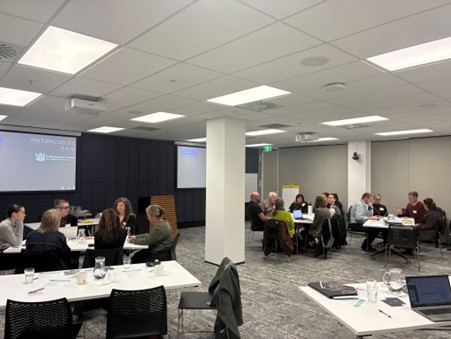
The workshop was designed as a practical forum to move beyond awareness of GBIF and into implementation. Participants worked through real use cases with a strong emphasis on:
- Fit-for-purpose data mobilisation – including monitoring, survey and observational data
- Indigenous Data Governance and CARE-aligned practices
- Interoperability with national systems and reporting frameworks
- Use of open, standardised biodiversity data

Workshop Key findings
Across the discussions, several themes were consistent:
- Shared understanding of GBIF’s role as trusted infrastructure for publishing, discovering and reusing biodiversity data
- Environmental information is fragmented and hard to reuse; GBIF offers shared infrastructure that can reduce duplication and improve discoverability.
- NZOR is foundational as the national standard taxonomy, but needs stable governance, sustainable funding, and clearer integration pathways (including via ChecklistBank).
- Governance is as important as technology: Māori data sovereignty, permissions (iwi/landowner), and consistent handling of sensitive/species-risk data must be addressed at policy level.
- Perception barriers remain (e.g., GBIF as “cream on top of the cake”); in practice, GBIF requires accurate mapping to standards and good metadata, and datasets can be improved after mobilisation.
- Capacity building is needed to sustain adoption (e.g., data camps, agency ambassadors, practical guidance/cookbooks).
Priorities identified
1. Scoping a National Biodiversity Information Facility (NBIF)
Participants gained a shared understanding of GBIF’s role as trusted infrastructure for publishing, discovering and reusing biodiversity data. A key recommendation was to scope a National Biodiversity Information Facility (including the existing GBIF Participant Node), drawing on international models and GBIF guidance. This would clarify governance, resourcing and technical capability to shift from ad hoc projects to a coherent federated system.
2. Strengthening national checklists through NZOR + GBIF’s ChecklistBank
Participants identified the need to strengthen the national “taxonomic foundation” and to use ChecklistBank to manage and integrate priority checklists (e.g., threatened species lists, invasive species lists, RPMP lists, ecosystem typologies) in a consistent, versioned and interoperable way.
3. Targeted pilots and case studies to demonstrate value
Breakout groups identified pilots that could quickly demonstrate value for councils and central government, including:
- restricted/sensitive data guidance (e.g., orchids; weeds on private land)
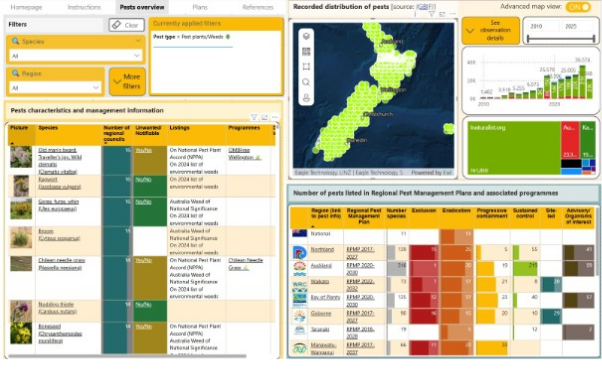
- integrating regional pest management plan lists
- enabling reporting and analysis using event-based monitoring data (e.g., DOC Tier 1 and council surveys)
- using GEO BON tools (e.g., Bon in a Box) to demonstrate national-level reporting capability
4. Priority datasets for mobilisation
Participants identified a range of priority data types and datasets to mobilise (including monitoring and long term datasets), and the need for a more systematic “data scan” to map what datasets exist, who holds them, and current accessibility.
What happens next
The report provides a clear evidence base for next steps, including:
- progressing priority data mobilisation activities
- strengthening governance arrangements and guidance
- building capability across agencies and partners
- embedding GBIF into existing monitoring, reporting and analytics workflows
The workshops provides a foundation for coordinated action rather than ad hoc or project by project approaches.These actions will be taken forward through ongoing collaboration between participating organisations and the GBIF New Zealand community.
Read the report
The full GBIF Workshop Report is now available and includes detailed discussion summaries, findings and references.
This workshop and report form part of New Zealand’s continued engagement with GBIF and our commitment to improving the accessibility, quality and governance of biodiversity data for people and nature.
Acknowledgements
This workshop was funded by the Ministry of Business, Innovation & Employment, with support from the GBIF New Zealand Node.
Thank you to all workshop participants from central and regional government and the wider biodiversity data community who contributed to the discussions, and to those progressing practical follow-up.
We are greatly appreciative of Kevin Collins (Collins Consulting) for leading preparation and facilitating the workshop and Sam Prescott (Sixteenth Letter) for preparing communication materials and assisting with the workshop.
For questions, follow-up, or to discuss potential pilot projects, please contact the GBIF New Zealand team.
- Meredith Mckay, GBIF New Zealand Head of Delegation, gbif.newzealand+hod@gmail.com
- Aaron Wilton, GBIF New Zealand Node Manager, gbif.newzealand+nodemanager@gmail.com